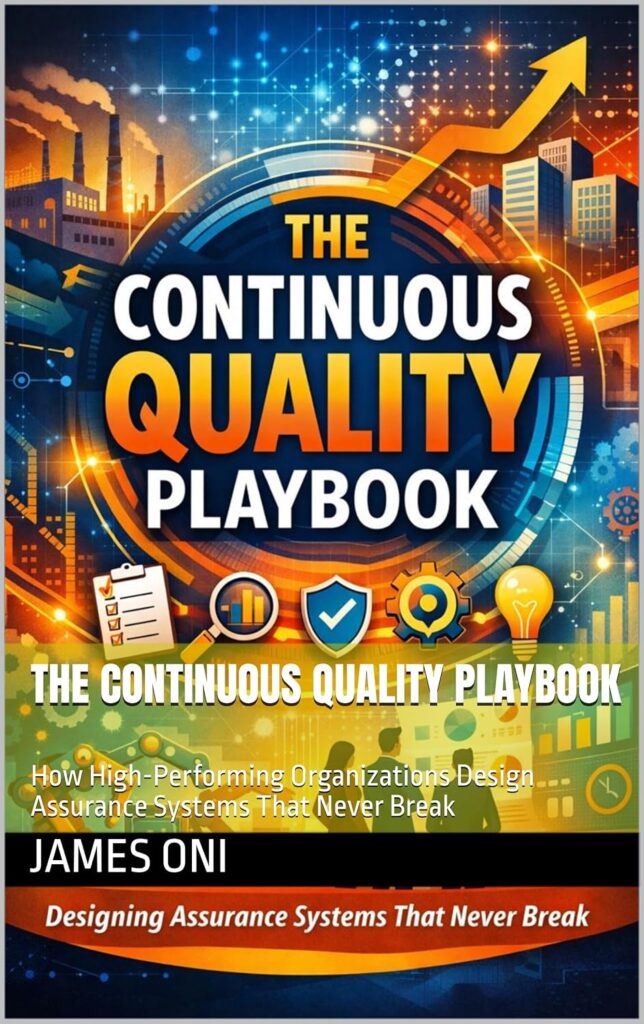
This book begins with a hard truth: most quality systems don’t fail because people ignore them—they fail because they were never designed to survive pressure.
In regulated and high-risk environments, quality is often treated as a function to manage, a department to staff, or a set of rules to enforce. Organizations invest heavily in policies, audits, certifications, and oversight structures, believing these will guarantee control. On paper, many of these systems appear mature. Under pressure, they fracture.
Audits expose gaps. Growth creates instability. Leadership change erodes continuity. Incidents reveal that controls worked only when conditions were ideal.
The Continuous Quality Playbook exists to explain why this happens—and how to design systems that don’t break when reality intervenes.
From Appearance to Reality
The book opens by dismantling the illusion of “mature” quality programs. It shows how inspection-heavy, compliance-driven models create the appearance of control while masking fragility. Audits are not validations of strength; they are stress tests that reveal whether systems function continuously or only when prepared.
Early chapters challenge the idea that quality can be owned by a department. They reframe quality as a system property, distributed across execution, management, and governance. Accountability belongs close to the work, while control must be designed centrally. Anything else produces either bureaucracy or chaos.
This sets the first major shift of the book:
quality is not enforced—it is engineered.
Assurance as Design, Not Review
As the narrative deepens, the focus moves from inspection to assurance. The book draws a clear distinction between finding problems and preventing them, between reviewing work and controlling systems.
Readers are introduced to the Five Pillars of Unbreakable Quality Systems—designed controls, operational transparency, evidence-based oversight, controlled change, and leadership accountability. These pillars form the architectural foundation for systems that remain stable under stress, scale, and scrutiny.
Rather than offering tools in isolation, the book explains how quality must be embedded into daily execution—at the point of work—so that evidence is generated naturally and deviation is visible immediately. SOPs become living systems. Frontline ownership is supported by management guardrails. Quality becomes part of how work happens, not something layered on afterward.
Improvement Without Risk
A central tension in regulated environments is the belief that improvement increases risk. The book directly confronts this fear.
It shows that the real danger is not improvement, but unmanaged drift—the silent erosion of controls through informal workarounds and outdated processes. When improvement is governed with clear guardrails, it strengthens assurance instead of weakening it.
Metrics are reframed as instruments of system health, not performance theater. Leading indicators, early-warning dashboards, and closed-loop improvement replace lagging reports and reassurance. Deviations are treated not as failures to punish, but as signals to redesign systems.
This section marks the second major shift of the book:
continuous improvement is a governance discipline, not an operational experiment.
Key points
- Publication date: Jan. 23 2026
- Language: English
- Pages: 75