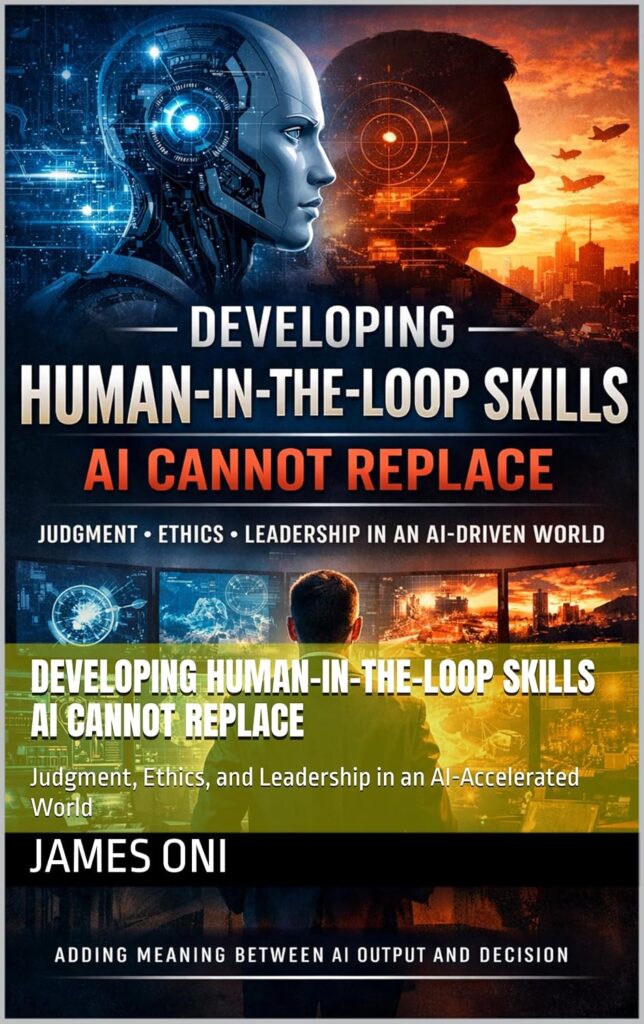
Developing Human-in-the-Loop Skills AI Cannot Replace
Judgment, Ethics, and Leadership in an AI-Accelerated World
Artificial intelligence is no longer experimental. It is operational. It detects threats, prioritizes risks, recommends actions, and increasingly sits upstream of decisions that carry legal, ethical, and national consequences.
Yet when failures occur—breaches, escalations, reputational damage, mission disruption—the explanation is often the same: “the system decided.”
This book rejects that premise.
Developing Human-in-the-Loop Skills AI Cannot Replace argues that AI does not fail organizations—leadership does. Not because leaders are careless or uninformed, but because judgment, ethics, and accountability have been treated as personal traits instead of professional disciplines. As AI accelerates analysis and compresses decision cycles, these human capabilities must be trained, practiced, and governed with the same rigor as technology itself.
This is not a book about building better algorithms.
It is a book about building better humans around algorithms.
Across cybersecurity, defence, public sector, and other high-stakes environments, AI excels at answering questions once they are framed. But it cannot determine which questions matter. It cannot weigh second-order consequences, reconcile competing values, or accept responsibility when outcomes cause harm. Those burdens remain human—and they are becoming heavier as automation scales.
The book reframes Human-in-the-Loop (HITL) from a procedural control into a leadership role. The human is not there to rubber-stamp automation, nor to slow progress out of fear. The human stands between AI output and irreversible consequence—integrating context, ethics, and accountability when speed alone is dangerous.
Structured across five parts, the narrative progresses from understanding meaning, to owning decisions, to designing oversight, to leading under uncertainty, and finally to embedding judgment into daily practice. Each chapter is grounded in realistic cybersecurity and defence scenarios, illustrating how technically correct decisions can still fail strategically—and how disciplined human leadership prevents silent failure.
Key themes include:
- Meaning over mechanics: why data and patterns are insufficient without context and intent
- Ownership and accountability: why AI can inform decisions but can never answer for them
- Trust through oversight: why safeguards matter more than accuracy in complex systems
- Leadership under uncertainty: why trust, authority, and moral courage cannot be automated
- Practice, not theory: how daily habits build judgment long before crises occur
Rather than offering abstract ethics or generic leadership advice, the book provides practical frameworks, case studies, and habits drawn from environments where mistakes are public, consequential, and irreversible. It speaks directly to executives, cybersecurity and defence leaders, policy makers, regulators, and program leaders who must approve, govern, or defend AI-enabled decisions.
The central argument is simple but demanding:
AI accelerates analysis.
Humans carry responsibility.
The future belongs to those who can stand calmly between speed and consequence.
In an era obsessed with automation, this book makes the case that the most valuable skillset is not technical brilliance, but responsible judgment under pressure. Those who develop it become the human firewall—trusted not because they are faster, but because they are accountable when it matters most.
Key points
- Publication date: Feb. 9 2026
- Language: English
- Pages: 49