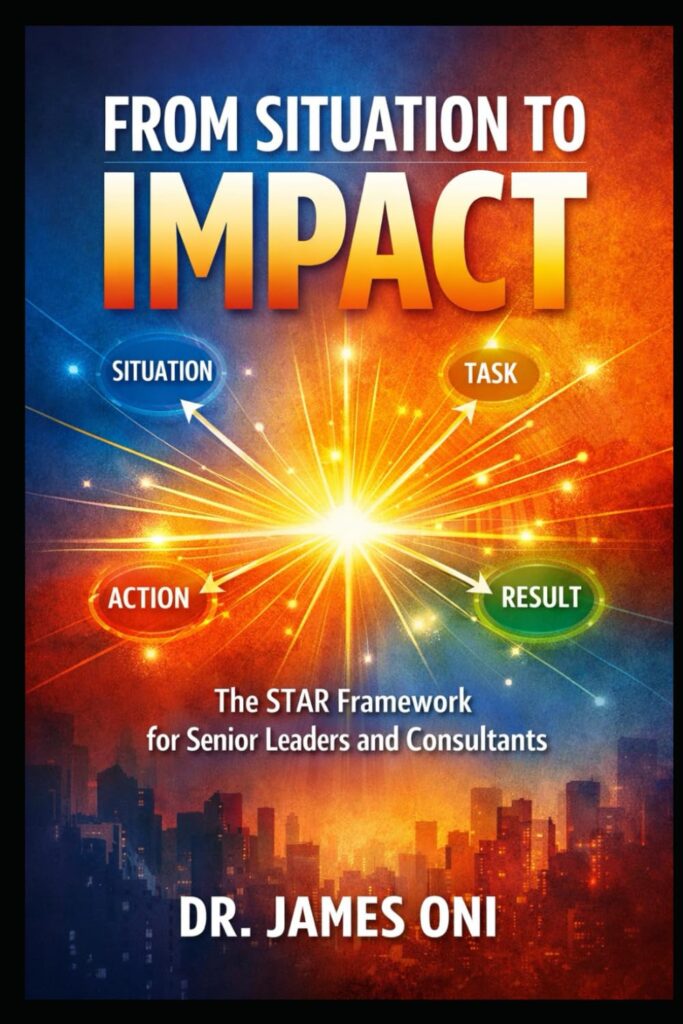
From Situation to Impact: The STAR Framework for Senior Leaders and Consultants
Leadership today unfolds in environments defined by complexity, scrutiny, and consequence. Decisions are made under regulatory constraint, political pressure, operational risk, and incomplete information. Authority is often shared, mandates are ambiguous, and failure carries costs that extend far beyond missed targets.
Yet most leadership frameworks still assume clarity, stability, and control.
From Situation to Impact is written for leaders and consultants who know better.
This book begins with a simple but uncomfortable truth: experience alone no longer guarantees influence. In modern institutions, credibility is earned not through tenure or effort, but through the ability to make sense of complexity, define accountability clearly, act with discipline, and demonstrate impact convincingly.
At the center of the book is a reframing of the STAR framework—Situation, Task, Action, Result—not as an interview technique, but as a leadership operating system. When elevated, STAR becomes a disciplined way to think, decide, communicate, and lead under pressure.
The narrative unfolds in four movements. Seeing the Real Situation
The first movement challenges one of the most common leadership failures: misdiagnosis. Leaders are rarely undone by poor execution; they are undone by acting on symptoms rather than understanding the real situation.
The book shows how experienced leaders learn to read organizations under stress, recognize political and regulatory context, and surface the problems that are never written down. It distinguishes urgency from importance, noise from signal, and activity from meaning. Readers are guided to slow down just enough to see clearly—before committing organizations to irreversible paths.
Owning Outcomes Without Authority
The second movement confronts the reality of modern leadership: accountability without control.
Most senior leaders and consultants operate in matrixed environments where authority is fragmented and success depends on influence rather than command. Here, the book reframes the concept of “task,” distinguishing between vague mandates and real accountability. It shows how leaders clarify success, translate ambiguity into ownership, and align stakeholders before execution begins.
This is where STAR becomes a tool of integrity. By defining tasks precisely, leaders prevent future conflict, reduce escalation, and create the conditions for disciplined delivery.
Acting Through Structure, Not Heroics . The third movement dismantles the myth of heroic leadership.
In high-stakes environments—defence, intelligence, finance, critical infrastructure—success is not achieved through extraordinary effort, but through governance, cadence, and decision architecture. The book explains how leaders design systems that make good outcomes repeatable and bad outcomes visible early.
Action, in this narrative, is not about doing more. It is about intervening deliberately, choosing the right delivery model for the context, and resisting the temptation to substitute firefighting for leadership. The book is explicit: sustained firefighting is not commitment—it is structural failure.
Delivering Results That Matter. Results form the spine of the book’s argument.
Not all results are equal, and many initiatives survive without succeeding. The narrative pushes leaders to distinguish between outputs and outcomes, vanity metrics and decision metrics, survival and success. It introduces the discipline of making impact visible—financially, operationally, reputationally, and strategically—so that work can be trusted, defended, and built upon.
Key points
- Publication date: Feb. 8 2026
- Language: English
- Pages: 83